Ask anyone who’s done both a game drive and a river cruise in Chobe National Park which one they’d repeat, and most will say the boat. Not because the drive was disappointing, but because the river shows you a version of Chobe that the roads simply can’t reach.
Key takeaways:
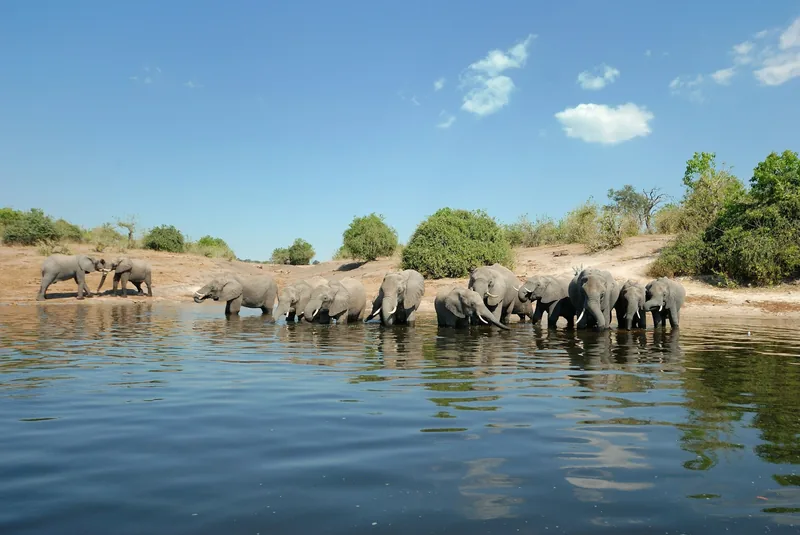
- Chobe has one of the highest elephant concentrations in Africa, and the river is where you see the largest herds; elephants gather at the water to drink, bathe, and cross, often in full view from a slow-moving boat.
- A river cruise puts you at eye level with hippo pods, crocodiles, and water birds that a 4×4 track simply doesn’t get you close to.
- Combining a land safari with a river cruise, rather than choosing one, is what most multi-day Chobe itineraries are actually built around.
What makes Chobe different in the first place
Chobe National Park sits in northern Botswana, along the river that shares its name and forms the border with Namibia’s Caprivi Strip. It’s part of the wider Kavango-Zambezi Transfrontier Conservation Area; a conservation corridor that spans five countries and gives elephants, buffalo, and other wide-ranging species room to move between Botswana, Namibia, Zambia, and Zimbabwe. Our guide to the Kavango-Zambezi region covers how that cross-border conservation model works if you want the fuller picture.
What that means on the ground is a very high concentration of wildlife pulled toward one river system, especially during the dry season when the Chobe becomes one of the only reliable water sources for miles.
That seasonal pull matters for planning. In the dry months, water becomes scarce away from the river, and animals concentrate along its banks in far greater numbers than you’d see at almost any other time of year. In the wetter months, wildlife disperses further from the river as seasonal pans and grazing open up elsewhere in the park, so sightings from the boat are typically less concentrated, even though the surrounding landscape is greener and arguably more scenic. Neither season is a bad time to cruise the Chobe; they’re just different trips, and worth knowing which one you’re booking into.
Why the river changes what you actually see
A land-based game drive puts you on tracks, at a fixed distance from the water, watching from the bank. A river cruise puts you on the water itself, which changes the encounter in a few concrete ways.
You get eye-level access to elephants at the water’s edge. Chobe’s elephant herds come down to the riverbank to drink and bathe throughout the day, and a boat can hold position quietly just metres away; far closer than a vehicle parked on the bank would get.
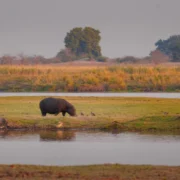
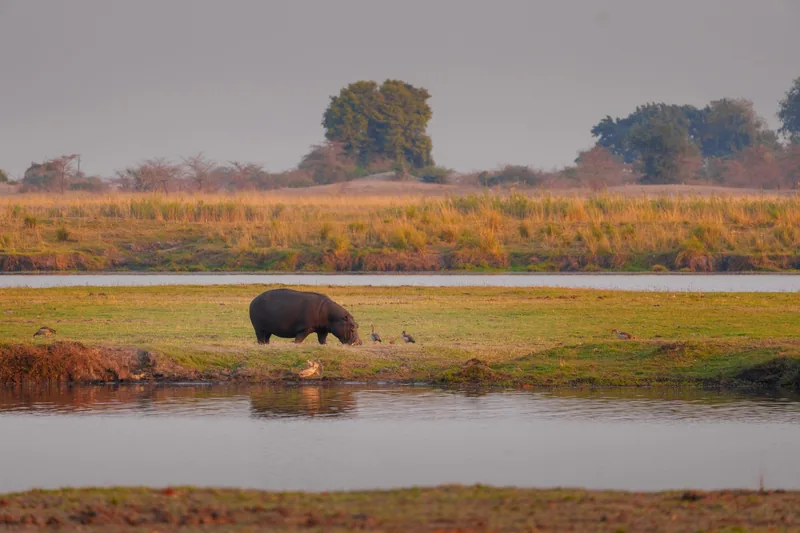
Hippos and crocodiles are river animals first. From land, you mostly see hippos as backs and ears above the water. From a boat moving along the same water, you see them properly: surfacing, interacting, occasionally challenging each other for territory.
The birdlife is genuinely different from the water. African fish eagles, herons, kingfishers, and African skimmers are far easier to spot and photograph from a slow boat moving along the reed line than from a vehicle on the road above it.
It’s a different pace entirely. A game drive covers ground looking for movement. A cruise drifts, engine idling or off, letting the wildlife come to the river on its own schedule. Many guests find the boat is where the best sightings actually happen, simply because you’re not driving past; you’re sitting still and letting Chobe come to you.
The light works differently on the water, too. Late-afternoon cruises put the sun behind you as you face the riverbank, which is generally kinder light for photography than the harsher midday light most game drives contend with on the road-bound side of a sighting.
Practical things worth knowing before you book
A cruise typically runs for one to two hours, usually scheduled for either early morning or the golden light before sunset; both ends of the day when animals are most active at the water. Small, open-sided boats are standard, holding anywhere from a handful of guests up to a larger group depending on the operator, and most run with a guide who doubles as boat pilot, pointing out what’s along the bank as you go. Bring a hat, sun protection, and a zoom lens if photography is part of why you’re there; the boat gets close, but a longer lens still helps with birdlife specifically.
Land drive or river cruise; or both
The honest answer is both, if your itinerary allows for it. A morning game drive covers the terrestrial wildlife: lions, giraffes, buffalo herds moving inland; and an afternoon or sundowner cruise covers everything that gathers at the water. Most multi-day Botswana itineraries are built around exactly this rotation rather than picking one over the other.
Our Delta & Chobe Trail routes run 10 days and combine a Chobe river cruise with time in the Okavango Delta, giving you both the water-based Chobe experience and the Delta’s mokoro-and-island landscape in one trip. If you want Etosha’s desert-adapted wildlife added to the same route, the Etosha, Delta & Chobe Trail extends the itinerary to 12 days. For a more accommodated version of the same combination, the Victoria Falls, Delta & Chobe route adds Victoria Falls to the mix over 12 days.
If you’re specifically after a shorter, Botswana-focused trip without the extra legs, Botswana Highlights covers the core Chobe-and-Delta experience over 7 days.
Where a river cruise fits into a longer Botswana trip
If Chobe is one stop on a longer Southern Africa route rather than the whole trip, it usually slots in near the end or the middle of an itinerary that also covers the Okavango Delta and, in some routes, Namibia’s Etosha or Victoria Falls. Building the cruise in alongside a land drive on the same day, rather than treating them as alternatives, is generally how our multi-day Chobe routes are structured; morning or afternoon on the water, the other half of the day on the road.
FAQ
Is a Chobe river cruise included in most Botswana safari itineraries?
On multi-day Chobe routes, yes; it’s typically built in alongside at least one land game drive, since the two cover different parts of the park’s wildlife.
What time of day is best for a Chobe cruise?
Late afternoon into sunset is the classic slot, when animals come down to drink after the heat of the day and the light is at its best for photography. Some itineraries also offer an early-morning cruise as an alternative.
Do you see the Big 5 from a river cruise?
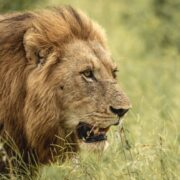
Elephant and buffalo, reliably. Lion and leopard are land-based sightings and won’t typically show up from the boat, which is exactly why pairing the cruise with a game drive matters.
Is Chobe better than the Okavango Delta, or should you do both?
They’re different experiences rather than competing ones; Chobe is river-and-elephant country, the Delta is wetland-and-mokoro country. Most itineraries that reach this part of Botswana combine both rather than choosing.
What should you pack for a river cruise?
Sun protection, a hat, something warm for early-morning departures (river air is noticeably cooler than on land), and binoculars or a zoom lens for birdlife along the banks.
Plan your Chobe leg properly.
If a river cruise is the part of the trip you’re most looking forward to, say so when you enquire; it affects which lodge and which itinerary makes sense, since not every route gives it equal weight. Get in touch with our team to build a Botswana route around it.